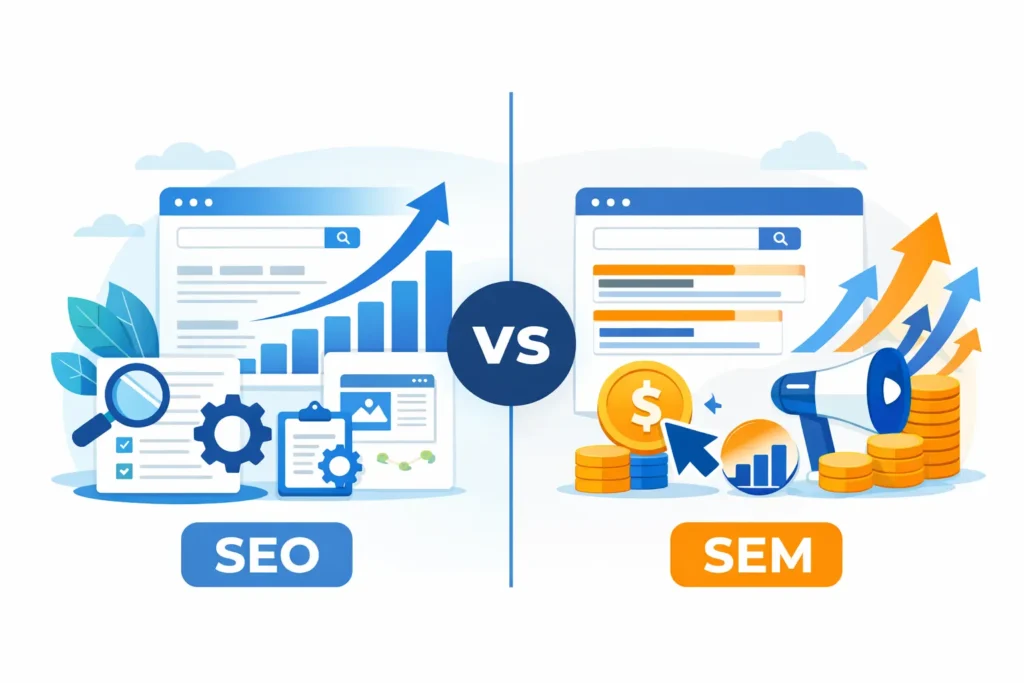
In today’s digital landscape, businesses are attempting to gain more visibility online by utilizing search engines, including Google, and by creating ways to reach new clients. The majority of companies employ two approaches for attaining improved search engine visibility: Search Engine Optimization (SEO) or Search Engine Marketing (SEM). Both strategies aim for increased visibility on search engines; however, they do so differently, and each serves different purposes.
When comparing SEO vs SEM, it’s important to understand how each strategy contributes to online visibility in different ways. While both SEO and SEM focus on search engine presence, choosing the right approach depends on your business goals, budget, and timeline.
Having a clear understanding of what is meant by the terms SEO and SEM, will help you determine how best to use them to establish an impactful brand and develop your online presence.
Table of Contents
Definition and Types of SEO.
SEO (Search Engine Optimization) is an approach that returns organically (i.e., unpaid) search engine results through the implementation of an optimized website with the goal of increasing traffic to the site. The intent is to gain increased traffic by making the website more visible/relevant to customers searching through any search engine.
SEO is the process of optimizing different areas of your website so that the search engines can identify and rank your website. Examples of these areas include keywords, website speed, website usability and quality of content (relevancy of content to search terms).
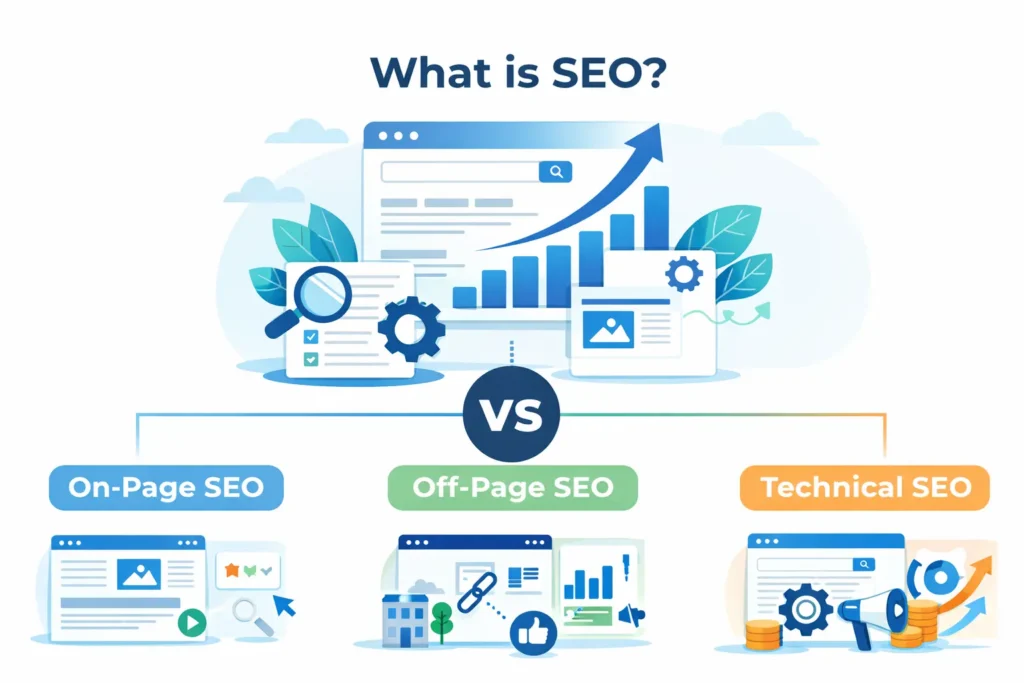
There are three main types of search engine optimization:
The first type is called “On-Page SEO”, which has to do with improving elements inside a website such as content, keywords, meta tags, internal links, and headings.
Next is “Off-Page SEO”, which is focused on increasing a website’s authority through backlinks, social signals from networks (such as Facebook and Twitter), and external references from other reputable sites.
Lastly, Technical SEO is responsible for making sure the website is technically sound through improving loading speed, mobile responsiveness, site structure, and indexing.
These SEO practices play a crucial role when evaluating SEO vs SEM, as they focus on building sustainable visibility rather than immediate paid exposure.
One of the best benefits of SEO is that it produces long-term results; after ranking a website well, visitors will continue to come to that website without needing additional advertising costs or efforts. However, SEO requires a lot of time and patience as most results will take several months before they can be noticed.
In the broader comparison of SEO vs SEM, SEO represents the organic, long-term approach to gaining search engine visibility without paying directly for clicks.
What is SEM?
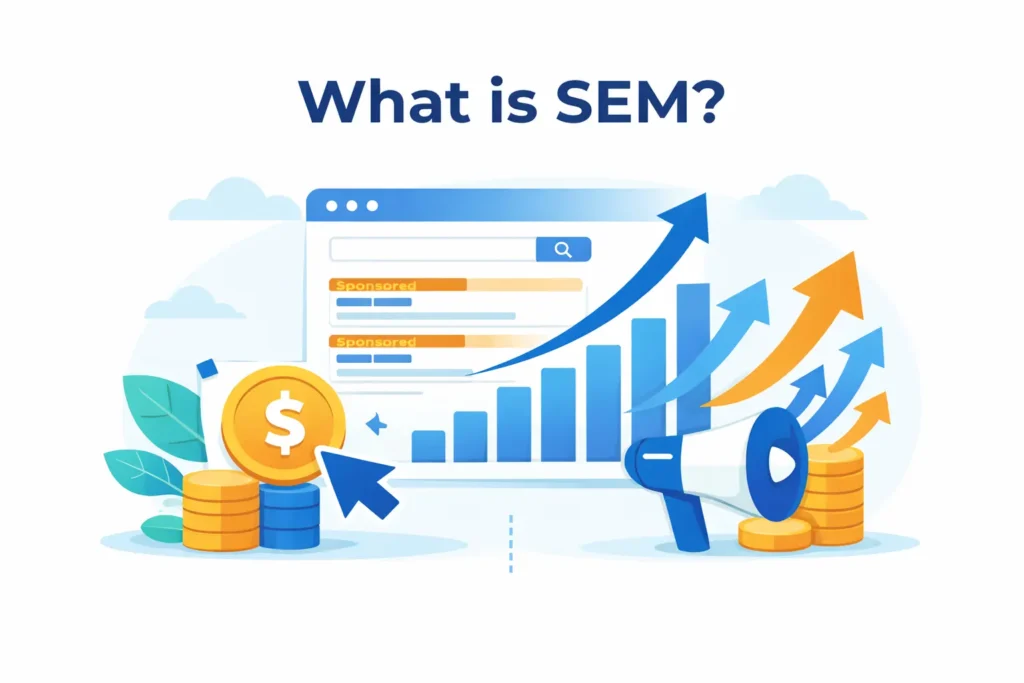
Search Engine Marketing (SEM) consists of paid advertising strategies to generate website visibility on search engines. One of the most common types of SEM is Pay-Per-Click (PPC) advertising, in which an advertiser pays a certain amount each time an individual clicks their advertisement.
In the discussion of SEO vs SEM, SEM is often considered the faster option due to its reliance on paid advertising and immediate placement in search results.
Platforms such as Google Ads allow advertisers to create advertisements that will show at the very top of search engine results pages (SERPS). Most of the ads will be labeled with text indicating “Sponsored” or “Ad”, so individuals can clearly differentiate between organic and paid results.
SEM (Search Engine Marketing) enables companies to focus on their target audience through keywords, demographics, geographical location, and online behaviour. This high degree of targeting and the ability to use SEM make it an effective and efficient way for companies to reach prospective customers almost immediately.
The primary difference between (search engine optimisation) SEO vs SEM is that SEO does not provide immediate results; however, SEM does. As soon as an advertising campaign begins running, a company can begin appearing in search results and getting visitors to their website. The downside to SEM, however, is that it requires continual funding because once you stop running your ads, you will stop getting website visitors.
While SEO and SEM provide the same end result of increasing visibility, they differ greatly in many aspects including cost, speed, and long-term success.
When focusing specifically on organic traffic (as opposed to paid traffic), SEO does not involve any direct payments made for clicks or visits. Instead, it focuses on optimising the company’s website, through time and effort. Instead, companies pay to advertise (purchase) space on a search engine to obtain visitors, and then they will incur a cost associated with the amount of people who click on their advertisements.
SEO is a strategy that builds a company’s reputation and trust over the long term,whereas SEM is a strategy that generates immediate visibility but will not generate any lasting impact after the advertising campaign has been completed.
The quality of content, user experience, and authority of a website are the main factors determining SEO performance; SEM, on the contrary, is more reliant on paid elements, such as Ad budgets, bidding strategies, and optimization techniques.
Each of the two options provides unique benefits based on individual business goals; therefore, there is no one-size-fits-all approach to deciding which method would work best for you.
The comparison of SEO vs SEM highlights a clear contrast between long-term organic growth and short-term paid visibility.
When Should You Use SEO?
When analyzing SEO vs SEM, SEO is the preferred choice for businesses focused on long-term growth and brand authority.
If you’re trying to achieve sustainable and long-term growth online, then you should consider using an SEO strategy; for example, you may want to develop your brand’s authority and reputation within your industry.
Since some businesses may not have a significant budget for marketing, SEO is often preferred because it doesn’t require them to directly pay for traffic to their site — although SEO does take time and consistent effort, the return on investment is very high when looked at over the long term.
In addition, if your site is focused on content-based strategies (such as blog posts/education resources/informational websites), you will likely see steady growth in both traffic through organic searches as well as brand awareness as time passes due to the positive reputation that comes from building customer loyalty.
Lastly, if you’re looking to build trust with customers or create a positive brand image, you will most likely use SEO as retesting shows consumers tend to trust organic results in comparison to paid ads.
When to Consider Using Search Engine Marketing (SEM)
In the SEO vs SEM decision-making process, SEM is ideal for businesses that need quick visibility and immediate traffic.
If your business needs a quick way to get immediate results or promote a special offer/descriptive product/service, then SEM is the best way to go. SEM is perfect for times when launching a new product, or promotional/sales/seasonal campaigns.
Often times, businesses competing in extremely competitive industries are using SEM so that they can get fast visibility compared to what they would get by using Organic SEO. They can pay for ads and have a good chance to show up in searches for keywords that are highly sought after even if their website has just been created.
SEM is also ideal for businesses to test out their marketing/advertising methods. Because of the fast pace of SEM, businesses can easily find out which keywords/landing pages/offers work best and apply those results to improve future marketing campaigns.
For businesses that have a decent amount of money to invest in marketing, SEM can provide a fast way to generate new leads and conversions while developing long-term Organic SEO plans simultaneously.
Why Combination of SEO and SEM is Common Among Businesses At Present
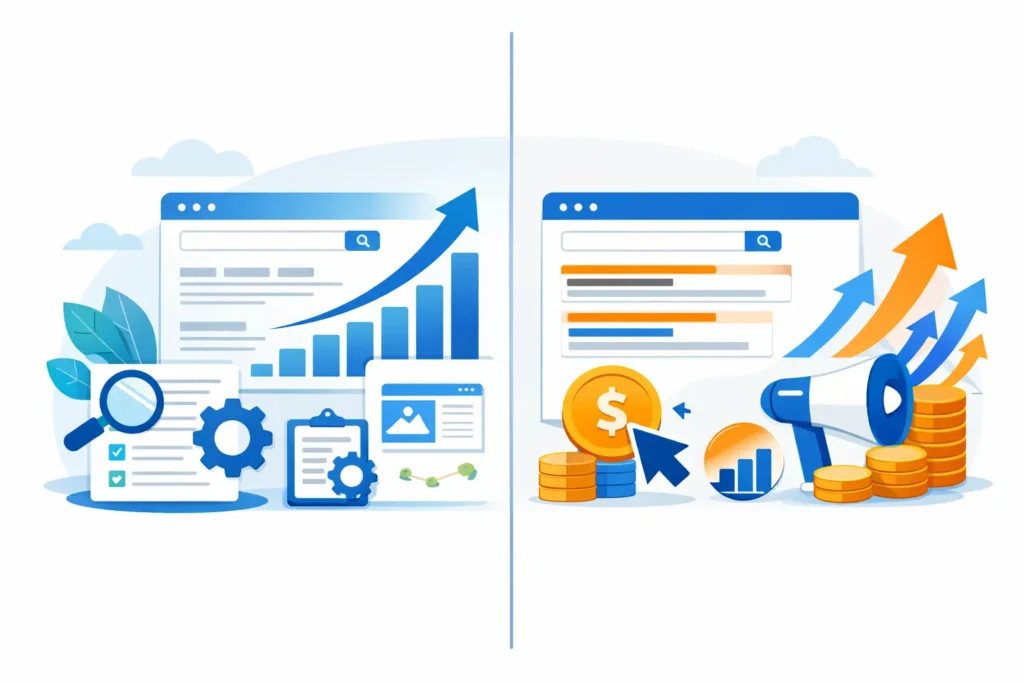
Many marketers no longer view SEO vs SEM as a choice between two options, but rather as complementary strategies that work best together.
Within the contemporary landscape of digital marketing, SEO (Search Engine Optimization) and SEM (Search Engine Marketing) are typically executed together. The best companies today will implement a combined strategy to obtain maximum results.
SEM provides immediate visibility to a business and allows for fast traffic generation. Conversely, SEO allows a business to build long-term and sustainable growth. Further, the data collected through SEM campaigns can assist marketers in determining which keywords are the highest performers and then target these keywords through their SEO strategy.
Combining both of these strategies provides for a well-rounded marketing strategy. Businesses can generate immediate or short-term success while developing a strong organic presence for the long-term.
SEO and SEM Trends in 2026
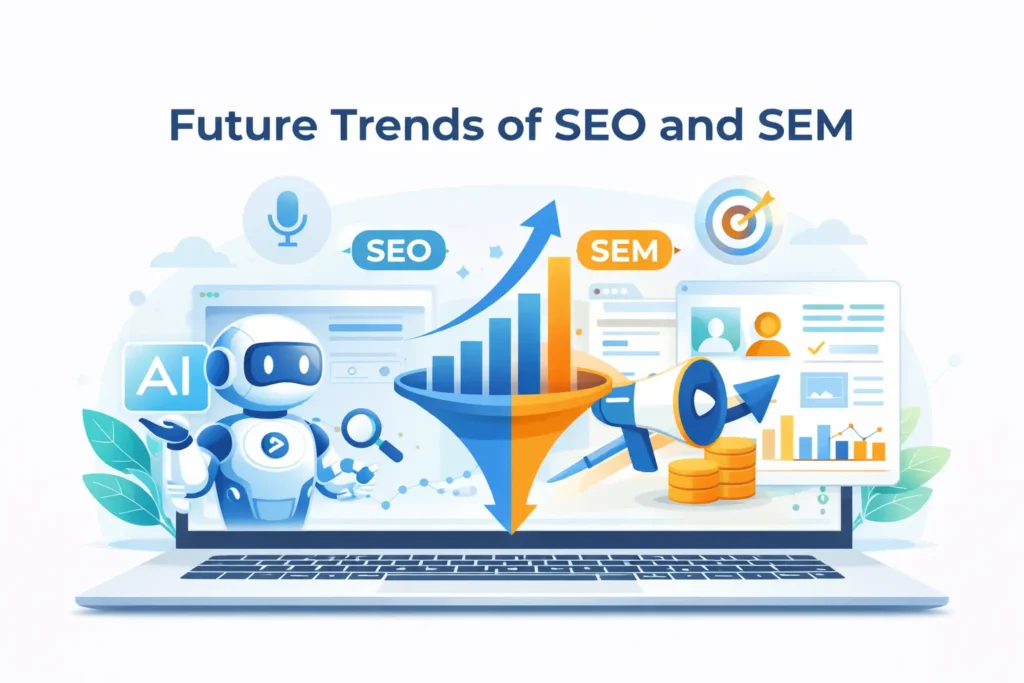
Looking ahead, the evolution of SEO vs SEM in 2026 is being shaped by AI, automation, and a stronger focus on user intent.
The digital marketing industry continues to evolve with new advancements in AI, voice search, and personalized customer experiences. Increasingly, search engines are focusing more on determining the user’s intent, rather than simply matching search terms.
At the time of the year 2026, SEO is going to be much more focused on producing high-quality content, user engagement, and technical performance of a website. Search engines are going to reward websites that offer true value and a seamless user experience.
SEM is focusing more on the use of data and automation. Advertising tools that are leveraging AI will be used to provide better bidding strategies, reach specific audiences, and deliver ads more effectively than ever.
Given an increase in competition, companies will need to implement smarter and more strategic marketing tactics to remain competitive.
Final Thoughts
Both SEO (Search Engine Optimization) and SEM (Search Engine Marketing) are effective ways to increase online visibility, but they do so through different means. While SEO is geared toward developing long-term, organic growth by establishing credibility and generating sustainable traffic, SEM gets businesses instant visibility (via paid advertising), accurately targets customers (demographics) and delivers immediate results.
Which option a business should choose between SEO and SEM is contingent upon its goals, budget and time line; to achieve immediate results, SEM would be the preferred choice, however, for businesses whose focus is on long-range brand development, SEO would be the best tactic.
Ultimately, the debate of SEO vs SEM is not about which strategy is better, but about how each can be used effectively based on business needs.
While it is true that either of these options will work independently and provide results, the best (or at least, most effective) way for a business to approach this issue would be to incorporate the two strategies; as a result, an organization would be able to experience faster growth, improved brand authority, and have overall greater success in marketing.
Within the digitally competitive arena, it will become increasingly important for businesses to understand and make the best use of both SEO and SEM as a means to succeed in their respective sectors.
We help businesses grow online through data-driven SEO, SEM, and performance-focused digital marketing strategies check : InterSellerMart
Our Associated Partners MarketFuels and OneHighSky