Digital marketing is evolving on a daily basis and businesses that want to remain competitive in 2026 must adapt to new technologies, new platforms, and changing consumer behavior. Traditional marketing or old marketing methods are no longer enough. Brands have to adapt new technologies, innovations, data driven, and customer focused digital marketing strategies to ensure long term growth and success.
Marketers who are aiming to build an effective digital marketing strategy need to have a clear understanding of their business goals, products, and target audience before choosing the approaches that will be effective for their needs.
In this blog, we’ll read the top digital marketing strategies that will help you boost customer engagement, increase brand awareness, and generate more leads to increase business growth in 2025.
Table of Contents
What is digital marketing?
Before the internet, businesses promoted themselves through using traditional methods like newspapers, billboards, direct mail, TV advertisement. But with time shopping and consumer experience has shifted online marketing and advertising have moved online too. Marketers can now reach their target audience by using digital channels such as social media, websites, search engines, text messages, and email; these are known as digital marketing.
Why is digital marketing important for you?
Digital marketing has several advantages in comparison to traditional marketing.
- With online marketing you can reach a wide range of audiences around the world.
- Personalisation helps to target segment specific groups.
- Your brand can get more visibility across multiple digital platforms.
- You can communicate with customers faster and more frequent
- Data collection and analysis help businesses to make better decisions.
- Automation helps you achieve more results efficiently and effectively with a low budget cost and small marketing team.
Process of building Digital Marketing Strategies
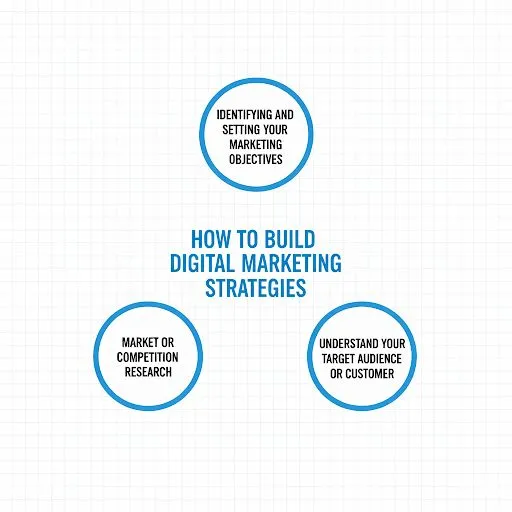
Identifying And Setting Your Marketing Objectives
To start your marketing strategy you need to identify and set clear objectives you need to determine what you want to achieve and what are your objectives and goals. Are you looking to improve brand awareness, increase sales, or reach to new customers who are interested in your product or service? Once your goals and objectives are clearly identified, you can start your marketing journey by doing research about your competitors and customers.
Understand your target audience or customer
Understanding your customer or target audience is an important part in ecommerce marketing. It gives a clear view of who buys your product, why they buy it, and where they buy it. And it also gives a clear picture of What are their interests, needs, and wants?
To understand your customers, you have to conduct market research. which can be as simple as sending surveys to current customers. With these surveys you can gather information like first-time visitors to a loyal, repeat customer and define customer segments using details like age, gender, income level, location, profession, and interests.
Once you have a clear understanding of your target customers you can start to design target marketing campaigns that directly address their interests and preference. And don’t forget customer feedback as it provides valuable data and information that can help you improve your products, services, and enhance the overall customer experience.
Market or competition research
Market or competitor analysis is an essential step. Once you know your objectives it’s important to conduct a competitive analysis to understand how they are pursuing their marketing goals. What strategies are they using to promote their services or product? What marketing tactics are effective for them
By understanding your competition you can make a marketing strategy that differentiates your brand and attracts new customers.
What are the most effective digital marketing strategies?
Content marketing
Content marketing is a digital marketing strategy focused on creating and sharing valuable high quality content and using digital channels to promote it. But instead of directly promoting products or services, content marketing aims to build trust, and educate customers. This is what’s known as content marketing
Content marketing offers variety of content formats such as:
- Videos
- Social media posts
- Blogs
- Articles
- Podcasts
High-quality content helps improve website visibility, attracts organic traffic, and guides potential customers through the buyer’s journey. Effective content marketing supports other digital marketing strategies such as search engine optimization (SEO) and social media marketing
Optimize SEO regularly
Search engine optimization (SEO) is an important strategy for digital marketing as it helps increase the online visibility of your brand, services, or product.
The objective of SEO is to optimize your content – whether it’s a homepage, landing page, or blog so it can be easily found by both existing and potential customers. It not only helps to drive traffic but it improves user experience and helps to boost your brand.
To successfully align with user intent, there are some key elements of SEO that should be consider:
- Keywords
- Images
- Backlinks
- Crawlability & Indexing
- Content quality
These SEO elements focuses on connecting your brand with the online users who are interested and actively searching for what you offer
Social Media Marketing
Social Media Marketing (SMM) is a key component of digital marketing strategies as it focuses on social media platforms like Instagram, Facebook, LinkedIn and X (Twitter) to promote your brand, product, or services and engage the audience.
It is one of the most powerful digital marketing strategies because it helps businesses to reach customers and influence people worldwide.
To perform successfully social media marketing there are some key components that should be consider:
- Targeted Ads – Social media platforms offer advanced targeting options based on age, gender, location, interests, profession, and behavior. By using these targeted ads, businesses can make their advertising campaigns more effective and cost-efficient.
- Lead Generation – Features like call to action (CTA) buttons, lead forms, and shoppable posts help convert followers into potential customers. They help businesses to get leads, and encourage engagement
- Reach – Social media helps businesses increase their brand visibility online. By posting content regularly, brands stay
present in the minds of their audience and with eye-catching visuals and graphics brands can be more recognizable to larger audiences.
- Audience Engagement – Audience engagement refers to the way businesses communicate with their audience on social media platforms. Actions such as likes, comments, allow brands to interact with customers in real time.shares
Influencer Marketing for Brand Growth with the Right Marketing Influencer
Influencer marketing is an important part of digital marketing strategies that focuses on collaborating with individuals who have a strong fan base and wider reach on social media platforms such as Instagram, YouTube, and Facebook to promote brands, products, or servicesthrough a trusted marketing influencer voice.
When selecting an influencer, it’s not only about the number of followers they have, it’s about how they engage with their audience the topics they promote and are passionate about. Choosing the right marketing influencer ensures the promotion feels authentic and connects with the target market. Once the right influencer is identified, creating a clear influencer marketing brief is essential to ensure both parties are on the same page in terms of goals, target audience and key message.
Ways of collaborating with influencers are:
- Gifting or providing samples for them to try and review
- Promoting an event with a relevant marketing influencer
- Sponsorship
- Podcast appearance
- Hosting a challenge or giveaway
- Use them as a host
Email Marketing
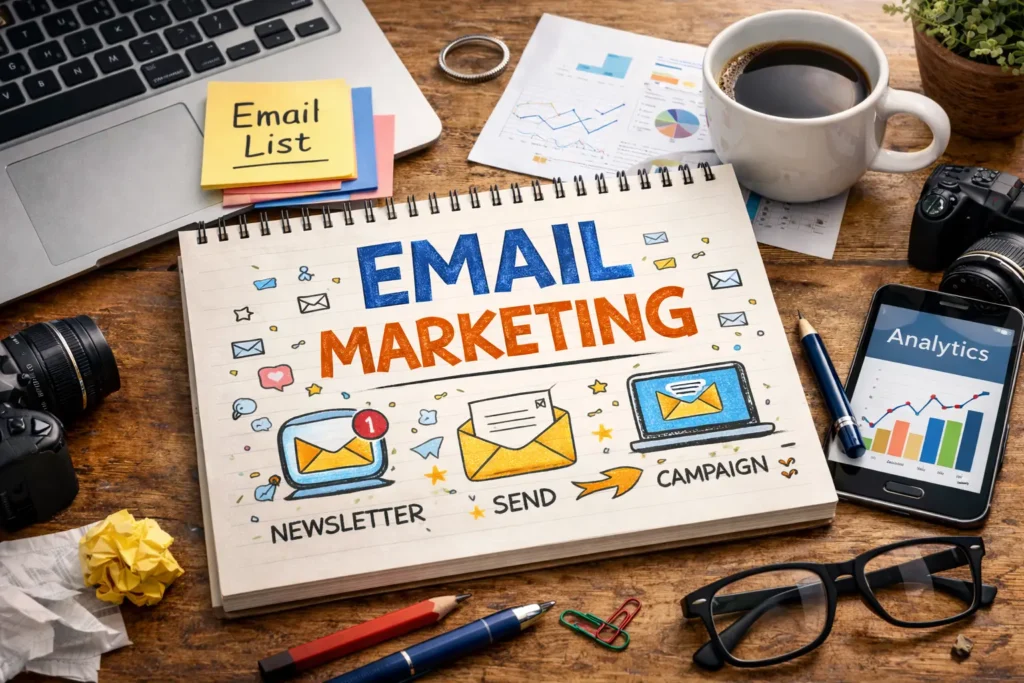
Email marketing is one of the most effective and cost-efficient digital marketing strategies it is used to communicate directly with customers. It helps in sending targeted business emails to a specific audience to promote products, share updates, and build long-term relationships
Email marketing allows businesses to inform and engage people or users who have already shown interest in their products or services, using data collected through third-party cookies and recent activities or past searches. Businesses can segment their email lists based on factors like customer behavior, interests, preferences, and purchase history ensuring that the right message reaches the right audience at the right time.
One of the biggest advantages of email marketing is that businesses can measure performances. It can track click through rates, open rates, engagement, and conversion. It helps them to optimize campaigns and improve results.
There are many methods businesses can use to collect customer information and grow their email lists like:
- Promote your social media channels
- call-to-action (CTA) buttons
- Running giveaways
- Promote an offer
- Adding pop-ups or sign-up forms
Paid advertising
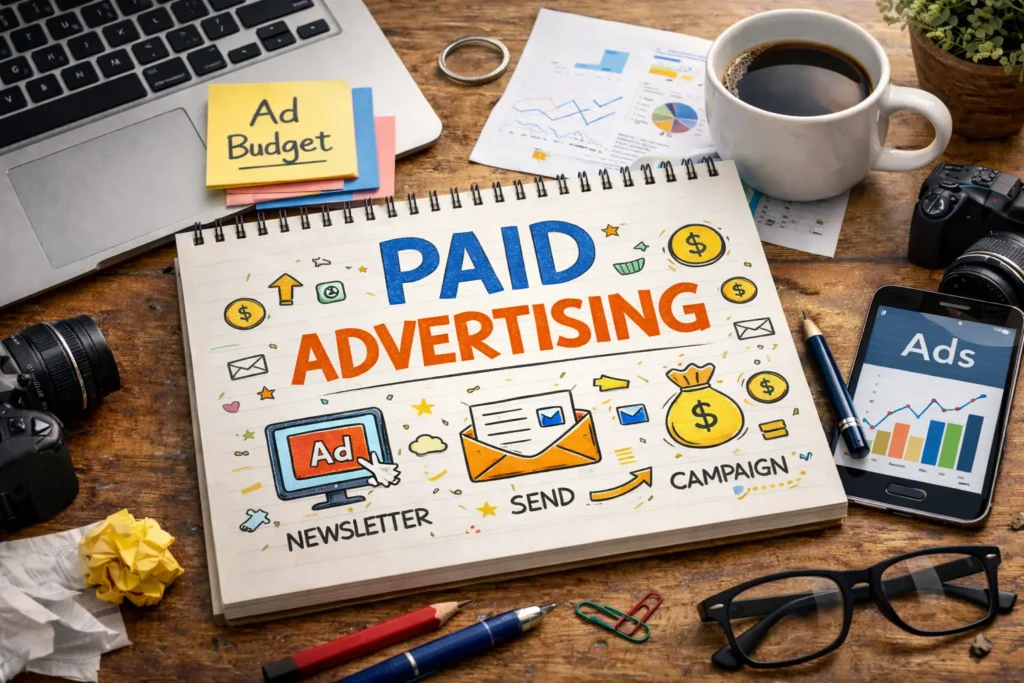
Paid advertising is a digital marketing strategy where businesses pay to display ads on platforms like Google, YouTube, Facebook, Instagram, and LinkedIn to reach their target audience it offers immediate visibility, quickly generate traffic, and sales especially when combined with a marketing influencer campaign for stronger credibility.
There are several types of paid advertising, including:
- Social Media Ads: Ads that run on social media platforms like Facebook, Instagram, or Linkedin.
- Pay-Per-Click (PPC) Ads: Advertisers will only pay when a user clicks on their ad.
- Video Advertising: Video ads are those ads which run on platforms like YouTube that are highly engaging and good for storytelling, help in brand building, and showcasing products.
Frequently Asked Questions (FAQs)
1. What is a digital marketing strategy?
A digital marketing strategy is a plan that frames how a business uses digital channels such as websites, social media, email, search engines, and content to reach its target audience and achieve marketing objectives.
2. How do you create a digital marketing strategy for a business?
We start by learning and understanding about your business and future goals, objectives, competitors ,and audience, then we develop a strategy that is designed to deliver measurable results, combining the right mix of SEO, content marketing, social media, influencer marketing, paid advertising, and performance tracking.
3. Is digital marketing suitable for small businesses?
Yes, digital marketing is also effective for small businesses as it is affordable, easy to measure, and allows to target a specific audience.
4. What are the elements of a digital marketing strategy?
Components of digital marketing strategies are content marketing, search engine optimization (SEO), social media marketing, influencer marketing, email marketing, and paid advertising. These components are selected based on your company’s future goals and audience interests, which are explained in more detail above.
5. How much time does it take for digital marketing to show results?
Results depend on the strategies you used. Like paid advertising delivers fast results, while SEO and content marketing usually take time to show impact but it provides long term benefits.
6. How can businesses check the growth of digital marketing strategy?
Businesses can track success through website traffic, audience engagement, conversion rates, lead generation, and return on investment (ROI). These all are key performance indicators.
7. Is it possible to change digital strategies over time?
of course. It should change with time because market trends, audience behavior, and business goals change. (because both business and digital marketing are dynamic) continuous monitoring and optimization are important to keep your strategy effective.
Conclusion
In conclusion, a planned digital marketing strategy helps businesses to build their online presence, connect with the right audience, and achieve steady growth. By using digital channels and regularly optimizing efforts with data-driven insights, businesses can build a good customer base and achieve long term growth.
Visit our homepage to explore all our services and resources.
Onehighsky Visit their official website to explore their services and latest posts.
Marketfuels for reference, you can check their official website here.